
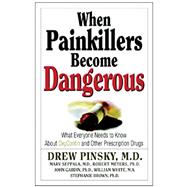
When Painkillers Become Dangerous
by Pinsky, DrewFormat: Paperback
Pub. Date: 2004-06-01
Publisher(s): Hazelden
 Other versions by this Author
List Price: $14.95
Rent Book
Select for Price
New Book
We're Sorry
Sold Out
Used Book
We're Sorry
Sold Out
eBook
We're Sorry
Not Available
How Marketplace Works:
- This item is offered by an independent seller and not shipped from our warehouse
- Item details like edition and cover design may differ from our description; see seller's comments before ordering.
- Sellers much confirm and ship within two business days; otherwise, the order will be cancelled and refunded.
- Marketplace purchases cannot be returned to eCampus.com. Contact the seller directly for inquiries; if no response within two days, contact customer service.
- Additional shipping costs apply to Marketplace purchases. Review shipping costs at checkout.
Summary
Americans, it seems, have a history of self-medicating for pain. The high profile and increasingly widespread cases of prescription pain medication abuse that we're seeing today serve as the latest chapter in America's long-standing love/hate relationship with painkilling drugs. In this fascinating, informative, and timely book, Dr. Drew Pinsky and other leading experts in the fields of addiction and recovery discuss why Americans are using drugs such as OxyContin and Vicodin, how American's used and abused other painkillers in the past, what makes some people vulnerable to addiction, and how to get help for yourself or a family member in trouble with drugs.
Author Biography
Drew Pinsky, M.D., is program medical director of chemical dependency services at Las Encinas Hospital in Pasadena, California. He is co-host of the nationally syndicated radio show Loveline and the long-running MTV program of the same name. He is author of the best-selling book Cracked: Putting Broken Lives Together Again. Dr. Pinsky is well known for his work on ABC News, Good Morning America, and CNN. When he is not spending time with his wife, Susan, and their eleven-year-old triplets, he lectures throughout the country and can be seen frequently providing commentary for television talk shows. Marvin D. Seppala, M.D., is corporate medical director at the Hazelden Foundation. Prior to working at Hazelden, Dr. Seppala was chief of psychiatry and an addiction medicine psychiatric consultant at Springbrook Northwest in Newberg, Oregon. Beginning in the 1980s, Dr. Seppala held a private practice and was a psychiatric consultant to several addiction treatment centers in the Portland, Oregon, and Minneapolis, Minnesota, areas. He is a member of the American Society of Addiction Medicine and a founding member of the Oregon Society of Addiction Medicine. Dr. Seppala is author of Clinician's Guide to the Twelve Step Principles. He and his wife, Linda, have two children and live in Wilsonville, Oregon. Robert J. Meyers, Ph.D., a research associate professor of psychology at the University of New Mexico and associate director of the LifeLink Training Institute in Santa Fe, New Mexico, created the scientifically validated Craft model that teaches family members how to intervene on loved ones who are abusing or addicted to alcohol and other drugs. Dr. Meyers is the co-author of Get Your Loved One Sober: Alternatives to Nagging, Pleading, and Threatening. John Gardin, Ph.D., has more than twenty-five years of experience in behavioral health care. He is a licensed psychologist with expertise in the treatment of addictive disorders and sexual abuse. He has also been the medical director and executive director of addiction programs in Oregon and southern California. Currently, Dr. Gardin is a co-founder and co-director of training at the LifeLink Training Institute and director of behavioral health services at the LifeLink family shelter in Santa Fe, New Mexico, and he is an adjunct professor of psychology at the University of New Mexico. William White, M.A., a senior research consultant at Chestnut Health Systems, has a master's degree in addiction studies and more than thirty-five years of experience working in the addictions field. He has authored/co-authored nine books including Slaying the Dragon: The History of Addiction Treatment and Recovery in America. Stephanie Brown, Ph.D., is a pioneering researcher, clinician, author, teacher, and consultant in the addiction field. She is the director of the Addictions Institute in Menlo Park, California, where she also has a private practice. She is a research associate at the Mental Research Institute in Palo Alto, California, where she co-directs the Family Recovery Research Project. Dr. Brown is the author of eight books. Her most recent book is A Place Called Self: Women, Sobriety, and Radical Transformation.
Table of Contents
| 1 OxyContin and Other Prescription Pain Medication, | 1 | (30) | |
|
|||
|
|||
| 2 How Addiction Treatment Works, | 31 | (34) | |
|
|||
| 3 How to Intervene on a Loved One's Addiction, | 65 | (34) | |
|
|||
| 4 OxyContin Addiction, | 99 | (40) | |
|
|||
|
|||
| 5 Addiction As a Family Disease, | 139 | (26) | |
|
|||
| Appendix A: Principles of Effective Treatment | 165 | (4) | |
| Appendix B: The Twelve Steps of Alcoholics Anonymous | 169 | (2) | |
| Notes | 171 | (10) | |
| About the Authors | 181 |
An electronic version of this book is available through VitalSource.
This book is viewable on PC, Mac, iPhone, iPad, iPod Touch, and most smartphones.
By purchasing, you will be able to view this book online, as well as download it, for the chosen number of days.
Digital License
You are licensing a digital product for a set duration. Durations are set forth in the product description, with "Lifetime" typically meaning five (5) years of online access and permanent download to a supported device. All licenses are non-transferable.
More details can be found here.
A downloadable version of this book is available through the eCampus Reader or compatible Adobe readers.
Applications are available on iOS, Android, PC, Mac, and Windows Mobile platforms.
Please view the compatibility matrix prior to purchase.