
 Other versions by this Author
This book expands on APA’s 2017 Multicultural Guidelines by exploring additional research and providing students and professionals with practical applications for clinical practice, teaching and training, research, and consultation.
As codevelopers of the guidelines, the authors provide their unique expertise in multicultural psychology, explaining how to develop cultural responsiveness and humility and become attuned to the diversity of human needs and experiences.
They also describe how to create constructive dialogues about social identity and build fruitful bidirectional relationships with clients, students, and organizations, among others.
This book takes an intersectional and ecological approach that considers a variety of cultural factors at multiple levels, ranging from small to large groups, to societal and cultural forces, and to historical changes. Within this layered ecological model, each of the ten guidelines is explored in depth in its own chapter, including illustrative case examples and discussion questions.
The book concludes with a comprehensive review that ties the ten multicultural guidelines together and highlights key takeaways, as well as providing future considerations for how multicultural psychology will evolve.
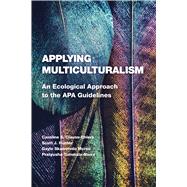
Applying Multiculturalism An Ecological Approach to the APA Guidelines
by Clauss-Ehlers, Caroline S.; Hunter, Scott J.; Morse, Gayle Skawennio; Tummala-Narra, PratyushaFormat: Paperback
Pub. Date: 2023-09-19
Publisher(s): American Psychological Association
List Price: $70.39
Buy New
Usually Ships in 5-7 Business Days
$70.32
Rent Textbook
Select for Price
Digital
$67.31*
Used Textbook
We're Sorry
Sold Out
How Marketplace Works:
- This item is offered by an independent seller and not shipped from our warehouse
- Item details like edition and cover design may differ from our description; see seller's comments before ordering.
- Sellers much confirm and ship within two business days; otherwise, the order will be cancelled and refunded.
- Marketplace purchases cannot be returned to eCampus.com. Contact the seller directly for inquiries; if no response within two days, contact customer service.
- Additional shipping costs apply to Marketplace purchases. Review shipping costs at checkout.
Summary
Author Biography
Caroline S. Clauss-Ehlers, PhD, ABPP, is a professor of psychology in the Department of Psychology at Long Island University-Brooklyn. Her research focuses on child and adolescent development with an emphasis on understanding cultural resilience and trauma within diverse community contexts. Dr. Clauss-Ehlers served as chair of the task force that developed APA’s 2017 Multicultural Guidelines. She received the 2014 American Counseling Association’s Exemplary Diversity Leadership Award and the 2018 Association of Multicultural Counseling and Development Distinguished Service Award for Exceptional Leadership and Devoted Service. She lives in New York City.
Scott J. Hunter, PhD, is a professor of psychiatry and behavioral neuroscience and pediatrics at the University of Chicago. A licensed clinical psychologist and developmental psychologist, Dr. Hunter is the director of neuropsychology for UChicago Medicine and Comer Children’s Hospital. As a pediatric neuropsychologist, he manages clinical programs and conducts research regarding socioeconomic impact and functional status on children, adolescents, and emerging adults with a range of neurodevelopmental and medical conditions. Dr. Hunter coedited four books published by Cambridge University Press, including Executive Function and Dysfunction: Identification, Assessment, and Treatment and Pediatric Neuropsychological Intervention.
Gayle Skawennio Morse, PhD, is a professor and the director of the Community Counseling Program at The Sage Colleges. Her research focuses on American Indian communities and examines the effects of toxic chemicals on human health and ethics and mental health treatment. Dr. Morse is the past president of the Society of Indian Psychologists, an APA fellow, and was awarded the APA Society for the Psychology of Women Section 6 Sweet Grass Award for dedication and professionalism in service. She is a member of the Akwesasne Kanienʼkehá꞉ka (Mohawk) people, from whom she draws principles that guide her professionally.
Pratyusha Tummala-Narra, PhD, is a professor of counseling, developmental, and educational psychology and director of doctoral training in counseling psychology at Boston College. Her research focuses on immigration, trauma, race, cultural competence, and psychoanalytic psychotherapy. She has chaired or served on multiple committees, including the Multicultural Concerns Committee and the APA Task Force on Revising the Multicultural Guidelines. Dr. Tummala-Narra is associate editor of the Asian American Journal of Psychology and Psychoanalytic Dialogues and senior psychotherapy editor of the Journal of Humanistic Psychology. She authored Psychoanalytic Theory and Cultural Competence in Psychotherapy and edited Trauma and Racial Minority Immigrants.
Table of Contents
Foreword: The Last Page and Dreams of the Future and the Weight of the Past
Joseph E. Trimble
Acknowledgments
Part I. Foundations of Multicultural Practice
Chapter 1. An Introduction to the Multicultural Guidelines
Chapter 2. The Layered Ecological Model of the Multicultural Guidelines
Part II. A Bidirectional Model of Self-Definition and Relationships
Chapter 3. Recognizing the Fluidity and Complexity of Self-Identify and Social Dynamics: Multicultural Guideline 1
Chapter 4. Understanding and Avoiding Psychologists’ Biases: Multicultural Guideline 2
Part III. Understanding Community, School, and Family Context
Chapter 5. The Cultural Significance of Language and Communication: Multicultural Guideline 3
Chapter 6. The Impact of Social Capital: Multicultural Guideline 4
Part IV. Considering the Institutional Impact on Engagement
Chapter 7. Recognizing Institutional Barriers and Systemic Marginalization: Multicultural Guideline 5
Chapter 8. Promoting Culture-Centered Interventions and Advocacy: Multicultural Guideline 6
Part V. Psychological Practice Within a Domestic and International Climate
Chapter 9. Understanding Globalization’s Impact on Psychology: Multicultural Guideline 7
Chapter 10. The Intersection Between Development and Biosociocultural Context: Multicultural Guideline 8
Part VI. Outcomes
Chapter 11. Conducting Culturally Informed Work in Psychology: Multicultural Guideline 9
Chapter 12. Applying a Strength-Based Approach to Psychology: Multicultural Guideline 10
Part VII. Future Directions in Multicultural Psychology
Chapter 13. Where Do We Go From Here? Looking Towards 2027 in Multicultural Psychology
Afterword
Lynn Pasquerella
References
Index
About the Authors
Joseph E. Trimble
Acknowledgments
Part I. Foundations of Multicultural Practice
Chapter 1. An Introduction to the Multicultural Guidelines
Chapter 2. The Layered Ecological Model of the Multicultural Guidelines
Part II. A Bidirectional Model of Self-Definition and Relationships
Chapter 3. Recognizing the Fluidity and Complexity of Self-Identify and Social Dynamics: Multicultural Guideline 1
Chapter 4. Understanding and Avoiding Psychologists’ Biases: Multicultural Guideline 2
Part III. Understanding Community, School, and Family Context
Chapter 5. The Cultural Significance of Language and Communication: Multicultural Guideline 3
Chapter 6. The Impact of Social Capital: Multicultural Guideline 4
Part IV. Considering the Institutional Impact on Engagement
Chapter 7. Recognizing Institutional Barriers and Systemic Marginalization: Multicultural Guideline 5
Chapter 8. Promoting Culture-Centered Interventions and Advocacy: Multicultural Guideline 6
Part V. Psychological Practice Within a Domestic and International Climate
Chapter 9. Understanding Globalization’s Impact on Psychology: Multicultural Guideline 7
Chapter 10. The Intersection Between Development and Biosociocultural Context: Multicultural Guideline 8
Part VI. Outcomes
Chapter 11. Conducting Culturally Informed Work in Psychology: Multicultural Guideline 9
Chapter 12. Applying a Strength-Based Approach to Psychology: Multicultural Guideline 10
Part VII. Future Directions in Multicultural Psychology
Chapter 13. Where Do We Go From Here? Looking Towards 2027 in Multicultural Psychology
Afterword
Lynn Pasquerella
References
Index
About the Authors
An electronic version of this book is available through VitalSource.
This book is viewable on PC, Mac, iPhone, iPad, iPod Touch, and most smartphones.
By purchasing, you will be able to view this book online, as well as download it, for the chosen number of days.
Digital License
You are licensing a digital product for a set duration. Durations are set forth in the product description, with "Lifetime" typically meaning five (5) years of online access and permanent download to a supported device. All licenses are non-transferable.
More details can be found here.
A downloadable version of this book is available through the eCampus Reader or compatible Adobe readers.
Applications are available on iOS, Android, PC, Mac, and Windows Mobile platforms.
Please view the compatibility matrix prior to purchase.